Girl It Must Be You Again You Are Sacred in a Way Dont Know God but Still Have Faith
Tomorrow's Gods: What is the future of religion?
(Image credit:
Getty Images
)
Throughout history, people's faith and their attachments to religious institutions have transformed, argues Sumit Paul-Choudhury. And so what'south next?
Earlier Mohammed, before Jesus, before Buddha, in that location was Zoroaster. Some 3,500 years ago, in Bronze Age Iran, he had a vision of the one supreme God. A 1000 years subsequently, Zoroastrianism, the globe's first great monotheistic organized religion, was the official faith of the mighty Western farsi Empire, its burn temples attended by millions of adherents. A m years later on that, the empire collapsed, and the followers of Zoroaster were persecuted and converted to the new religion of their conquerors, Islam.
Another 1,500 years later – today – Zoroastrianism is a dying faith, its sacred flames tended past ever fewer worshippers.
We take information technology for granted that religions are born, grow and die – but we are also oddly blind to that reality. When someone tries to start a new religion, information technology is oftentimes dismissed equally a cult. When nosotros recognise a organized religion, we care for its teachings and traditions as timeless and sacrosanct. And when a faith dies, it becomes a myth, and its merits to sacred truth expires. Tales of the Egyptian, Greek and Norse pantheons are now considered legends, not holy writ.
Fifty-fifty today's ascendant religions take continually evolved throughout history. Early Christianity, for example, was a truly wide church: ancient documents include yarns almost Jesus' family life and testaments to the nobility of Judas. Information technology took iii centuries for the Christian church to consolidate around a canon of scriptures – and so in 1054 it split into the Eastern Orthodox and Catholic churches. Since so, Christianity has continued both to grow and to splinter into ever more disparate groups, from silent Quakers to snake-handling Pentecostalists.
You might besides similar:
• How and why did religion evolve?
• Do humans have a organized religion instinct?
• How long tin can civilisation survive?
If y'all believe your faith has arrived at ultimate truth, you might refuse the thought that it will change at all. Just if history is any guide, no thing how deeply held our behavior may be today, they are likely in time to be transformed or transferred equally they pass to our descendants – or merely to fade abroad.
If religions have changed and then dramatically in the past, how might they change in the future? Is there any substance to the merits that belief in gods and deities will die out altogether? And as our culture and its technologies get increasingly complex, could entirely new forms of worship emerge? (Find out what it would mean if AI developed a "soul".)
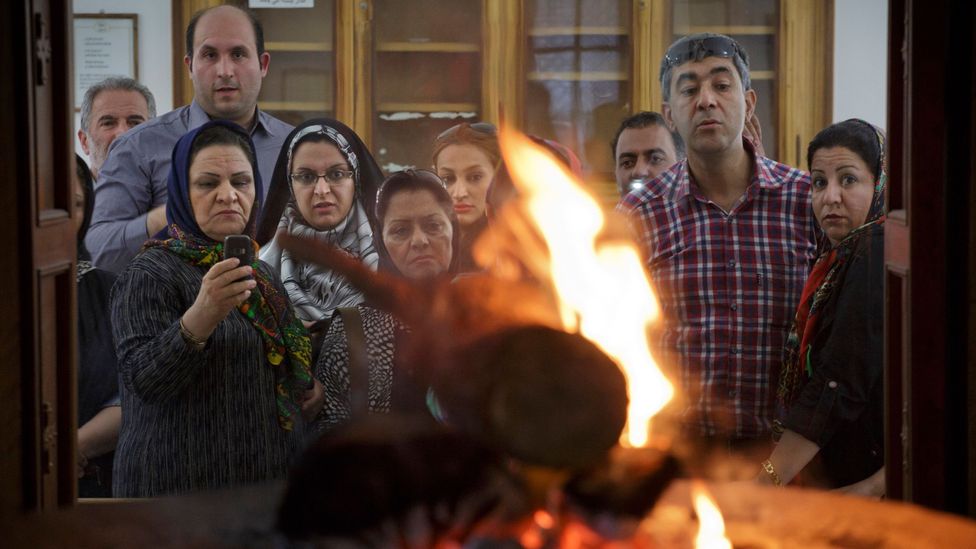
A flame burns in a Zoroastrian Fire Temple, possibly for more than a millennium (Credit: Getty Images)
To answer these questions, a expert starting point is to ask: why do we have religion in the outset place?
Reason to believe
1 notorious reply comes from Voltaire, the 18th Century French polymath, who wrote: "If God did not be, it would be necessary to invent him."Because Voltaire was a trenchant critic of organised religion, this quip is frequently quoted cynically. But in fact, he was being perfectly sincere. He was arguing that belief in God is necessary for society to function, even if he didn't corroborate of the monopoly the church held over that belief.
Many mod students of religion agree. The wide idea that a shared religion serves the needs of a lodge is known equally the functionalist view of religion. There are many functionalist hypotheses, from the idea that religion is the "opium of the masses", used by the powerful to control the poor, to the proposal that faith supports the abstract intellectualism required for scientific discipline and law. One recurring theme is social cohesion: organized religion brings together a community, who might then form a hunting party, heighten a temple or support a political party.
Those faiths that endure are "the long-term products of extraordinarily complex cultural pressures, selection processes, and evolution", writes Connor Wood of the Heart for Mind and Culture in Boston, Massachusetts on the religious reference website Patheos, where he blogs near the scientific report of faith. New religious movements are born all the time, simply near don't survive long. They must compete with other faiths for followers and survive potentially hostile social and political environments.
Under this argument, any religion that does endure has to offer its adherents tangible benefits. Christianity, for example, was simply one of many religious movements that came and mostly went during the grade of the Roman Empire. According to Forest, information technology was prepare autonomously by its ethos of caring for the sick – significant more than Christians survived outbreaks of disease than infidel Romans. Islam, too, initially attracted followers by emphasising accolade, humility and clemency – qualities which were not endemic in turbulent seventh-Century Arabia. (Read about the "light triad" traits that can make yous a expert person.)
Given this, nosotros might await the course that religion takes to follow the function it plays in a detail society – or equally Voltaire might have put it, that different societies will invent the detail gods they need. Conversely, we might expect like societies to have like religions, even if they accept adult in isolation. And at that place is some prove for that – although when it comes to religion, there are ever exceptions to any rule.
Belief in "Big Gods" allowed the formation of societies made up of strangers (Credit: Getty Images)
Hunter-gatherers, for case, tend to believe that all objects – whether animate being, vegetable or mineral – have supernatural aspects (animism) and that the world is imbued with supernatural forces (animatism). These must be understood and respected; human morality generally doesn't figure significantly. This worldview makes sense for groups besides small-scale to need abstract codes of acquit, but who must know their environs intimately. (An exception: Shinto, an ancient animist organized religion, is still widely practised in hyper-modernistic Japan.)
At the other finish of the spectrum, the teeming societies of the West are at least nominally faithful to religions in which a single watchful, all-powerful god lays down, and sometimes enforces, moral instructions: Yahweh, Christ and Allah. The psychologist Ara Norenzayan argues information technology was belief in these "Big Gods" that allowed the germination of societies made up of big numbers of strangers. Whether that belief constitutes cause or effect has recently been disputed, only the consequence is that sharing a faith allows people to co-exist (relatively) peacefully. The knowledge that Big God is watching makes certain we behave ourselves.
Or at least, it did. Today, many of our societies are huge and multicultural: adherents of many faiths co-exist with each other – and with a growing number of people who say they have no religion at all. Nosotros obey laws made and enforced by governments, not by God. Secularism is on the ascent, with science providing tools to understand and shape the globe.
Given all that, there'due south a growing consensus that the future of religion is that it has no future.
Imagine there's no heaven
Powerful intellectual and political currents take driven this suggestion since the early on 20th Century. Sociologists argued that the march of scientific discipline was leading to the "disenchantment" of society: supernatural answers to the big questions were no longer felt to exist needed. Communist states like Soviet Russian federation and China adopted atheism every bit country policy and frowned on even private religious expression. In 1968, the eminent sociologist Peter Berger told the New York Times that by "the 21st Century, religious believers are likely to exist found just in modest sects, huddled together to resist a worldwide secular culture".
Now that we're actually in the 21st Century, Berger'south view remains an article of organized religion for many secularists – although Berger himself recanted in the 1990s. His successors are emboldened past surveys showing that in many countries, increasing numbers of people are proverb they have no religion. That's most truthful in rich, stable countries similar Sweden and Nihon, but also, perhaps more surprisingly, in places similar Latin America and the Arab world. Even in the US, long a conspicuous exception to the axiom that richer countries are more secular, the number of "nones" has been rising sharply. In the 2018 General Social Survey of US attitudes, "no faith" became the single largest group, edging out evangelical Christians.
Despite this, religion is not disappearing on a global calibration – at least in terms of numbers. In 2015, the Pew Research Center modelled the time to come of the earth'due south slap-up religions based on demographics, migration and conversion. Far from a precipitous decline in religiosity, information technology predicted a minor increase in believers, from 84% of the globe's population today to 87% in 2050. Muslims would grow in number to lucifer Christians, while the number unaffiliated with whatsoever religion would decline slightly.

Modern societies are multicultural where followers of many dissimilar faiths alive next (Credit: Getty Images)
We besides need to be careful when interpreting what people hateful by "no faith". "Nones" may be disinterested in organised organized religion, but that doesn't mean they are militantly atheist. In 1994, the sociologist Grace Davie classified people according to whether they belonged to a religious group and/or believed in a religious position. The traditionally religious both belonged and believed; hardcore atheists did neither. And so there are those who belong just don't believe – parents attending church building to go a place for their kid at a faith school, possibly. And, finally, in that location are those who believe in something, but don't vest to any group.
The research suggests that the terminal two groups are pregnant. The Understanding Unbelief project at the Academy of Kent in the UK is conducting a 3-year, six-nation survey of attitudes among those who say they don't believe God exists ("atheists") and those who don't think information technology'south possible to know if God exists ("agnostics"). In interim results released in May 2019, the researchers found that few unbelievers actually place themselves by these labels, with significant minorities opting for a religious identity.
What'south more, around three-quarters of atheists and nine out of x agnostics are open to the beingness of supernatural phenomena, including everything from astrology to supernatural beings and life later death. Unbelievers "showroom meaning multifariousness both within, and between, different countries.
Accordingly, there are very many ways of existence an unbeliever", the report concluded – including, notably, the dating-website cliche "spiritual, simply not religious". Like many cliches, it's rooted in truth. But what does information technology really mean?
The quondam gods render
In 2005, Linda Woodhead wrote The Spiritual Revolution, in which she described an intensive study of belief in the British town of Kendal. Woodhead and her co-author establish that people were speedily turning away from organised religion, with its emphasis on fitting into an established order of things, towards practices designed to accentuate and foster individuals' own sense of who they are. If the boondocks'due south Christian churches did not embrace this shift, they concluded, congregations would dwindle into irrelevance while cocky-guided practices would become the mainstream in a "spiritual revolution".
Today, Woodhead says that revolution has taken place – and not only in Kendal. Organised religion is waning in the United kingdom of great britain and northern ireland, with no real terminate in sight. "Religions do well, and always have done, when they are subjectively convincing – when you lot accept the sense that God is working for you," says Woodhead, at present professor of sociology of religion at the Academy of Lancaster in the Uk.
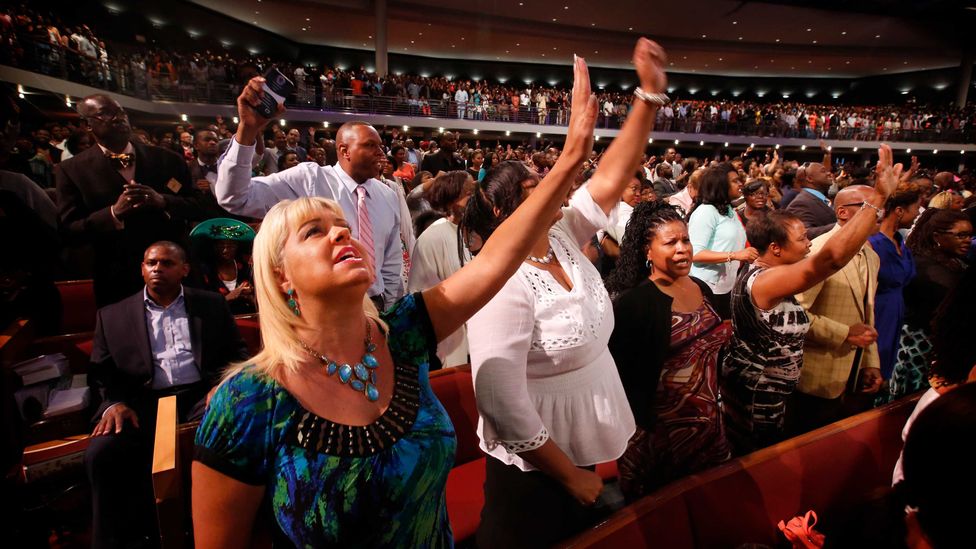
The states megachurches bring in thousands of worshippers (Credit: Getty Images)
In poorer societies, you might pray for good fortune or a stable job. The "prosperity gospel" is central to several of America's megachurches, whose congregations are oft dominated by economically insecure congregations. Simply if your basic needs are well catered for, you are more likely to be seeking fulfilment and meaning. Traditional religion is declining to deliver on this, particularly where doctrine clashes with moral convictions that ascend from secular society – on gender equality, say.
In response, people have started constructing faiths of their own.
What exercise these self-directed religions look like? One arroyo is syncretism, the "pick and mix" approach of combining traditions and practices that often results from the mixing of cultures. Many religions accept syncretistic elements, although over fourth dimension they are assimilated and become unremarkable. Festivals like Christmas and Easter, for example, have primitive pagan elements, while daily practice for many people in Red china involves a mixture of Mahayana Buddhism, Taoism and Confucianism. The joins are easier to run across in relatively young religions, such as Vodoun or Rastafarianism.
An alternative is to streamline. New religious movements oftentimes seek to preserve the central tenets of an older religion while stripping it of trappings that may have go stifling or erstwhile-fashioned. In the West, one form this takes is for humanists to rework religious motifs: there have been attempts to rewrite the Bible without any supernatural elements, calls for the construction of "atheist temples" defended to contemplation. And the "Sun Assembly" aims to recreate the atmosphere of a lively church service without reference to God. Simply without the deep roots of traditional religions, these can struggle: the Lord's day Associates, later initial rapid expansion, is now reportedly struggling to keep upward its momentum.
Only Woodhead thinks the religions that might emerge from the electric current turmoil will have much deeper roots. The first generation of spiritual revolutionaries, coming of age in the 1960s and 1970s, were optimistic and universalist in outlook, happy to take inspiration from faiths effectually the world. Their grandchildren, however, are growing upwardly in a earth of geopolitical stresses and socioeconomic angst; they are more likely to hark back to supposedly simpler times. "There is a pull away from global universality to local identities," says Woodhead.
DEEP Culture
This article is part of a BBC Time to come series well-nigh the long view of humanity, which aims to stand dorsum from the daily news cycle and widen the lens of our current place in fourth dimension.
Modern order is suffering from "temporal exhaustion", the sociologist Elise Boulding once said. "If one is mentally out of breath all the time from dealing with the nowadays, at that place is no energy left for imagining the time to come," she wrote.
That's why the Deep Culture season is exploring what really matters in the broader arc of human history and what it ways for us and our descendants.
"It'south actually of import that they're your gods, they weren't only made up."
In the European context, this sets the stage for a resurgence of interest in paganism. Reinventing half-forgotten "native" traditions allows the expression of mod concerns while retaining the patina of age. Paganism besides often features divinities that are more like lengthened forces than anthropomorphic gods; that allows people to focus on issues they feel sympathetic towards without having to make a leap of faith to supernatural deities.
In Iceland, for example, the small-scale but fast-growing Ásatrú faith has no detail doctrine beyond somewhat arch celebrations of Old Norse community and mythology, but has been active on social and ecological issues. Similar movements exist across Europe, such every bit Druidry in the Great britain. Not all are liberally inclined. Some are motivated by a desire to return to what they see as conservative "traditional" values – leading in some cases to clashes over the validity of opposing beliefs.
These are niche activities at the moment, and might sometimes be more about playing with symbolism than heartfelt spiritual exercise. But over time, they canevolve into more heartfelt and coherent belief systems: Woodhead points to the robust adoption of Rodnovery – an often conservative and patriarchal pagan faith based around the reconstructed beliefs and traditions of the ancient Slavs – in the one-time Soviet Union as a potential exemplar of things to come up.
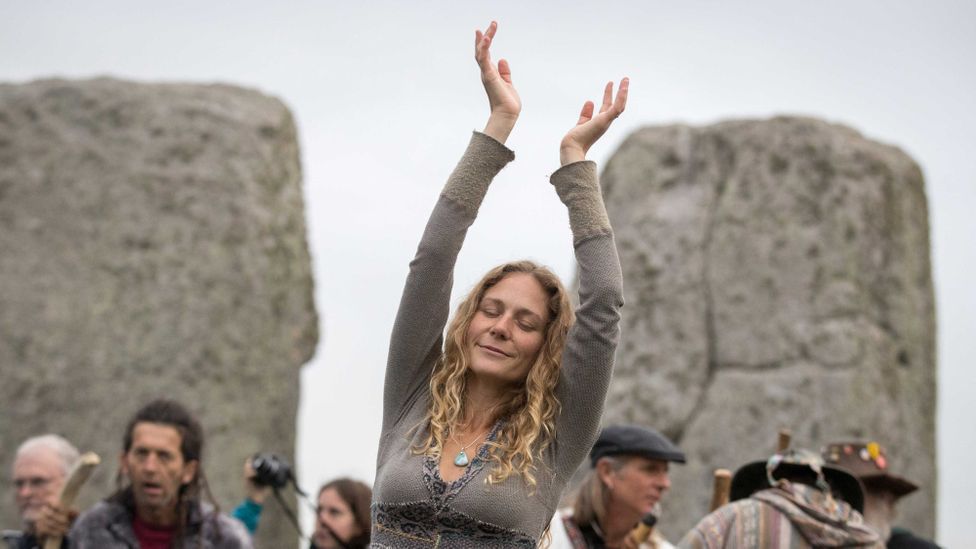
A adult female dances as druids, pagans and revellers gather at Stonehenge (Credit: Getty Images)
And then the nones generally represent not atheists, nor fifty-fifty secularists, but a mixture of "apatheists" – people who just don't intendance virtually religion – and practitioners of what you might call "disorganised religion". While the earth religions are likely to persist and evolve for the foreseeable future, we might for the rest of this century see an efflorescence of relatively small religions jostling to suspension out amid these groups. Only if Big Gods and shared faiths are key to social cohesion, what happens without them?
One nation nether Mammon
One answer, of course, is that we simply get on with our lives. Munificent economies, adept government, solid instruction and effective rule of law can ensure that nosotros rub along happily without whatsoever kind of religious framework. And indeed, some of the societies with the highest proportions of non-believers are amid the near secure and harmonious on World.
What remains debatable, however, is whether they tin beget to be irreligious because they accept strong secular institutions – or whether being secular has helped them attain social stability. Religionists say even secular institutions accept religious roots: civil legal systems, for example, codify ideas almost justice based on social norms established by religions. The likes of the New Atheists, on the other manus, argue that faith amounts to little more than superstition, and abandoning it will enable societies to ameliorate their lot more finer.
Connor Wood is not then certain. He contends that a strong, stable society similar Sweden's is both extremely circuitous and very expensive to run in terms of labour, money and free energy – and that might non exist sustainable even in the short term. "I think it's pretty articulate that nosotros're inbound into a period of non-linear alter in social systems," he says. "The Western consensus on a combination of market capitalism and democracy can't exist taken for granted."
That'southward a trouble, since that combination has radically transformed the social environment from the i in which the globe religions evolved – and has to some extent supplanted them.
"I'd be careful nigh calling capitalism a religion, but a lot of its institutions take religious elements, as in all spheres of homo institutional life," says Wood. "The 'invisible hand' of the market almost seems similar a supernatural entity."
Financial exchanges, where people meet to bear highly ritualised trading activity, seem quite like temples to Mammon, as well. In fact, religions, even the defunct ones, can provide uncannily appropriate metaphors for many of the more intractable features of modern life.
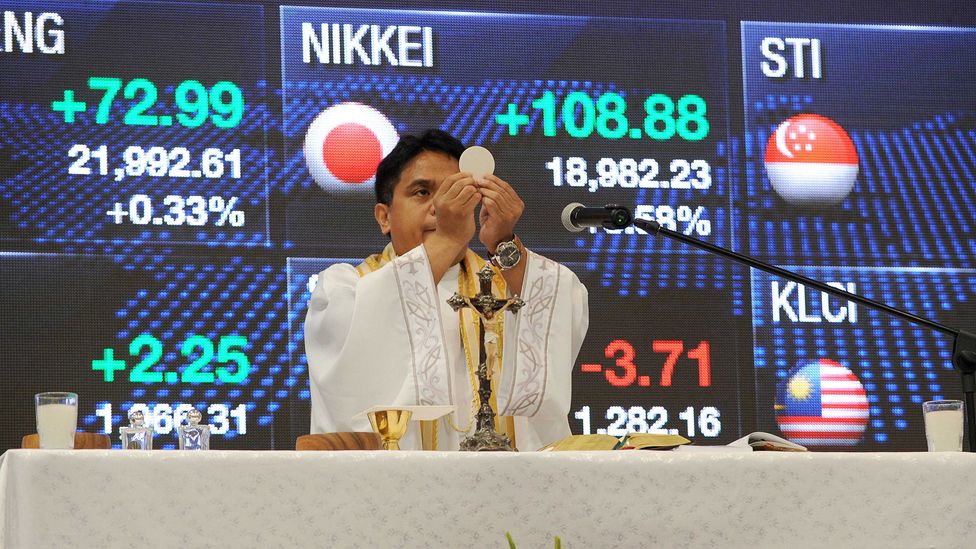
A Roman Catholic priest officiates mass on the get-go day of trading at the Philippine Stock Exchange in Manila (Credit: Getty Images)
The pseudo-religious social order might work well when times are proficient. Merely when the social contract becomes stressed – through identity politics, culture wars or economic instability – Wood suggests the consequence is what nosotros meet today: the rise of authoritarians in country afterward state. He cites research showing that people ignore authoritarian pitches until they sense a deterioration of social norms.
"This is the human animal looking around and saying we don't agree how we should deport," Woods says. "And we need authority to tell us." Information technology's suggestive that political strongmen are often hand in glove with religious fundamentalists: Hindu nationalists in India, say, or Christian evangelicals in the The states. That'south a strong combination for believers and an unsettling one for secularists: can anything bridge the gap betwixt them?
Mind the gap
Perhaps one of the major religions might change its class plenty to win back non-believers in significant numbers. There is precedent for this: in the 1700s, Christianity was ailing in the US, having go dull and formal fifty-fifty as the Age of Reason saw secular rationalism in the dominant. A new guard of travelling fire-and-brimstone preachers successfully reinvigorated the faith, setting the tone for centuries to come – an event chosen the "Corking Awakenings".
The parallels with today are easy to draw, just Woodhead is sceptical that Christianity or other world religions tin can make up the footing they have lost, in the long term. Once the founders of libraries and universities, they are no longer the key sponsors of intellectual thought. Social alter undermines religions which don't accommodate it: earlier this year, Pope Francis warned that if the Catholic Church didn't admit its history of male domination and sexual abuse it risked becoming "a museum". And their tendency to claim we sit at the pinnacle of creation is undermined past a growing sense that humans are non so very significant in the thousand scheme of things.
Perhaps a new religion will sally to fill the void? Again, Woodhead is sceptical. "Historically, what makes religions ascension or fall is political support," she says, "and all religions are transient unless they go majestic support." Zoroastrianism benefited from its adoption by the successive Farsi dynasties; the turning point for Christianity came when it was adopted by the Roman Empire. In the secular West, such support is unlikely to be forthcoming, with the possible exception of the US. In Russia, by contrast, the nationalistic overtones of both Rodnovery and the Orthodox church building wins them tacit political backing.
Merely today, there's some other possible source of back up: the internet.
Online movements gain followers at rates unimaginable in the past. The Silicon Valley mantra of "movement fast and break things" has get a cocky-axiomatic truth for many technologists and plutocrats. #MeToo started out equally a hashtag expressing anger and solidarity but now stands for real changes to long-standing social norms. And Extinction Rebellion has striven, with considerable success, to trigger a radical shift in attitudes to the crises in climatic change and biodiversity.
None of these are religions, of form, but they do share parallels with nascent belief systems – particularly that fundamental functionalist objective of fostering a sense of community and shared purpose. Some have confessional and sacrificial elements, too. So, given fourth dimension and motivation, could something more than explicitly religious grow out of an online customs? What new forms of faith might these online "congregations" come with?
We already accept some thought.
Deus ex machina
A few years ago, members of the self-declared "Rationalist" customs website LessWrong began discussing a thought experiment almost an omnipotent, super-intelligent automobile – with many of the qualities of a deity and something of the Old Testament God's vengeful nature.
Information technology was called Roko's Basilisk. The full proffer is a complicated logic puzzle, simply crudely put, it goes that when a benevolent super-intelligence emerges, information technology volition desire to do as much good as possible – and the earlier information technology comes into existence, the more good information technology volition exist able to practice. So to encourage everyone to do everything possible to help to bring into being, it volition perpetually and retroactively torture those who don't – including anyone who so much as learns of its potential existence. (If this is the first you've heard of information technology: lamentable!)

An artificial super-intelligence could have some of the qualities of a deity (Credit: Getty Images)
Outlandish though it might seem, Roko's Basilisk caused quite a stir when it was kickoff suggested on LessWrong – enough for give-and-take of it to be banned by the site's creator. Predictably, that merely made the idea explode across the cyberspace – or at least the geekier parts of it – with references to the Basilisk popping up everywhere from news sites to Doctor Who, despite protestations from some Rationalists that no-1 really took it seriously. Their case was not helped by the fact that many Rationalists are strongly committed to other startling ideas almost artificial intelligence, ranging from AIs that destroy the world by blow to human-auto hybrids that would transcend all mortal limitations.
Such esoteric behavior have arisen throughout history, but the ease with which we can at present build a community effectually them is new. "Nosotros've e'er had new forms of religiosity, merely nosotros haven't ever had enabling spaces for them," says Beth Singler, who studies the social, philosophical and religious implications of AI at the University of Cambridge. "Going out into a medieval boondocks square and shouting out your unorthodox behavior was going to get you labelled a heretic, not win converts to your cause."
The machinery may be new, only the message isn't. The Basilisk argumentis in much the same spirit as Pascal's Wager. The 17th-Century French mathematician suggested not-believers should still go through the motions of religious observance, merely in case a vengeful God does turn out to be. The idea of penalty as an imperative to cooperate is reminiscent of Norenzayan's "Big Gods". And arguments over means to evade the Basilisk's gaze are every bit every bit convoluted every bit the medieval Scholastics' attempts to square human freedom with divine oversight.
Even the technological trappings aren't new. In 1954, Fredric Brownish wrote a (very) brusque story chosen "Answer", in which a galaxy-spanning supercomputer is turned on and asked: is in that location a God? Now there is, comes the reply.
And some people, similar AI entrepreneur Anthony Levandowski, think their holy objective is to build a super-machine that will one twenty-four hour period answer simply every bit Dark-brown'southward fictional auto did. Levandowski, who made a fortune through cocky-driving cars, hit the headlines in 2017 when information technology became public knowledge that he had founded a church, Way of the Futurity, dedicated to bringing well-nigh a peaceful transition to a earth generally run past super-intelligent machines. While his vision sounds more benevolent than Roko'due south Basilisk, the church's creed still includes the ominous lines: "Nosotros believe it may be of import for machines to run across who is friendly to their crusade and who is non. We plan on doing so past keeping track of who has done what (and for how long) to help the peaceful and respectful transition."
"At that place are many ways people think of God, and thousands of flavours of Christianity, Judaism, Islam," Levandowski told Wired. "Merely they're always looking at something that's not measurable or you tin't really see or control. This fourth dimension it's different. This fourth dimension you lot will be able to talk to God, literally, and know that it's listening."
Reality bites
Levandowski is non alone. In his bestselling volume Homo Deus, Yuval Noah Harari argues that the foundations of modernistic civilisation are eroding in the face of an emergent faith he calls "dataism", which holds that by giving ourselves over to information flows, we can transcend our earthly concerns and ties. Other fledgling transhumanist religious movements focus on immortality – a new spin on the promise of eternal life. Still others ally themselves with older faiths, notably Mormonism.
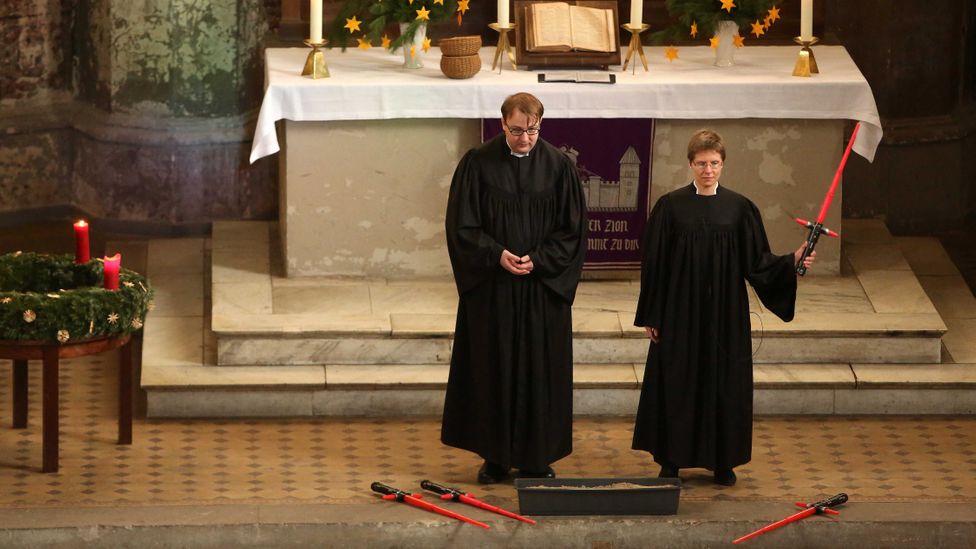
A church service in Berlin uses Star Wars to engage the congregation (Credit: Getty Images)
Are these movements for real? Some groups are performing or "hacking" organized religion to win support for transhumanist ideas, says Singler. "Unreligions" seek to dispense with the supposedly unpopular strictures or irrational doctrines of conventional religion, and so might entreatment to the irreligious. The Turing Church, founded in 2011, has a range of catholic tenets – "We will go to the stars and find Gods, build Gods, become Gods, and resurrect the expressionless" – just no hierarchy, rituals or proscribed activities and only one ethical maxim: "Endeavour to act with honey and compassion toward other sentient beings."
Only as missionary religions know, what begins as a mere flirtation or idle curiosity – perhaps piqued by a resonant statement or highly-seasoned ceremony – tin stop in a sincere search for truth.
The 2001 UK demography constitute that Jediism, the fictional organized religion observed past the adept guys in Star Wars, was the 4th largest religion: nearly 400,000 people had been inspired to claim it, initially by a natural language-in-cheek online campaign. Ten years later on, it had dropped to seventh identify, leading many to dismiss it as a prank. But as Singler notes, that is withal an awful lot of people – and a lot longer than near viral campaigns endure.
Some branches of Jediism remain jokey, merely others accept themselves more seriously: the Temple of the Jedi Social club claims its members are "real people that alive or lived their lives co-ordinate to the principles of Jediism" – inspired by the fiction, just based on the real-life philosophies that informed it.
With those sorts of numbers, Jediism "should" have been recognised as a religion in the United kingdom of great britain and northern ireland. Only officials who plain causeless it was not a genuine census answer did not record it as such. "A lot is measured against the Western Anglophone tradition of religion," says Singler. Scientology was barred from recognition as a religion for many years in the Britain because information technology did not have a Supreme Beingness – something that could likewise exist said of Buddhism.
In fact, recognition is a complex issue worldwide, especially since that there is no widely accustomed definition of organized religion even in academic circles. Communist Vietnam, for example, is officially atheist and often cited as i of the earth'south most irreligious countries – only sceptics say this is really because official surveys don't capture the huge proportion of the population who practice folk religion. On the other hand, official recognition of Ásatrú, the Icelandic heathen organized religion, meant it was entitled to its share of a "religion revenue enhancement"; as a result, it is building the state'due south starting time heathen temple for nearly 1,000 years.
Scepticism nearly practitioners' motives impedes many new movements from beingness recognised equally genuine religions, whether past officialdom or past the public at large. But ultimately the question of sincerity is a red herring, Singler says: "Whenever someone tells you their worldview, y'all have to take them at confront value". The acrid test, as true for neopagans as for transhumanists, is whether people make significant changes to their lives consistent with their stated religion.
And such changes are exactly what the founders of some new religious movements want. Official status is irrelevant if you can win thousands or even millions of followers to your crusade.

A Russian church in Antarctica, where climate change is playing out (Credit: Getty Images)
Consider the "Witnesses of Climatology", a fledgling "religion" invented to foster greater commitment to action on climatic change. After a decade spent working on engineering science solutions to climate change, its founder Olya Irzak came to the decision that the real problem lay not some much in finding technical solutions, but in winning social support for them. "What'southward a multi-generational social construct that organises people around shared morals?" she asks. "The stickiest is faith."
And so three years ago, Irzak and some friends set almost building one. They didn't see any need to bring God into information technology – Irzak was brought up an atheist – but did start running regular "services", including introductions, a sermon eulogising the awesomeness of nature and education on aspects of environmentalism. Periodically they include rituals, particularly at traditional holidays. At Contrary Christmas, the Witnesses constitute a tree rather than cut 1 downward; on Glacier Memorial Solar day, they sentinel blocks of ice cook in the California sun.
Equally these examples suggest, Witnesses of Climatology has a parodic feel to it – calorie-free-heartedness helps novices get over whatsoever initial clumsiness – but Irzak's underlying intent is quite serious.
"We hope people go real value from this and are encouraged to work on climate change," she says, rather than despairing about the state of the world. The congregation numbers a few hundred, simply Irzak, as a practiced engineer, is committed to testing out ways to abound that number. Among other things, she is because a Sunday School to teach children ways of thinking about how complex systems piece of work.
Recently, the Witnesses have been looking further afield, including to a anniversary conducted across the Middle East and central Asia just before the spring equinox: purification by throwing something unwanted into a burn – a written wish, or an bodily object – and then jumping over information technology. Recast as an attempt to rid the earth of environmental ills, it proved a pop addition to the liturgy. This might take been expected, because it's been practised for thousands of years as part of Nowruz, the Iranian New Year – whose origins lie in function with the Zoroastrians.
Transhumanism, Jediism, the Witnesses of Climatology and the myriad of other new religious movements may never amount to much. Only perhaps the same could have been said for the small groups of believers who gathered effectually a sacred flame in aboriginal Iran, three millennia agone, and whose fledgling belief grew into 1 of the largest, most powerful and enduring religions the world has e'er seen – and which is even so inspiring people today.
Maybe religions never do really die. Peradventure the religions that span the globe today are less durable than we retrieve. And perhaps the next great religion is just getting started.
--
Sumit Paul-Choudhury is a freelance writer and former editor-in-main of New Scientist. He tweets @sumit .
Join more than one million Future fans by liking us on Facebook , or follow us on Twitter or Instagram .
If y'all liked this story, sign up for the weekly bbc.com features newsletter , called "The Essential List". A handpicked selection of stories from BBC Hereafter, Culture, Capital letter, and Travel, delivered to your inbox every Friday.
Source: https://www.bbc.com/future/article/20190801-tomorrows-gods-what-is-the-future-of-religion

Postar um comentário for "Girl It Must Be You Again You Are Sacred in a Way Dont Know God but Still Have Faith"